As global industries seek alternatives to petroleum-based plastics, PHA plastic (polyhydroxyalkanoate) has emerged as one of the most promising next-generation biodegradable materials.
Unlike many traditional plastics, PHA is produced by microorganisms through natural fermentation processes. This unique origin allows PHA plastics to biodegrade in a wide range of environments, including soil, marine environments, and industrial composting systems.
Because of these properties, PHA is increasingly studied for use in sustainable packaging, medical materials, and biodegradable consumer products.
In this guide, we explain what PHA plastic is, how it is produced, and how it compares with other compostable plastics such as PLA and starch-based materials.
For an overview of biodegradable materials, see our guide to biodegradable plastics.
What Is PHA Plastic?
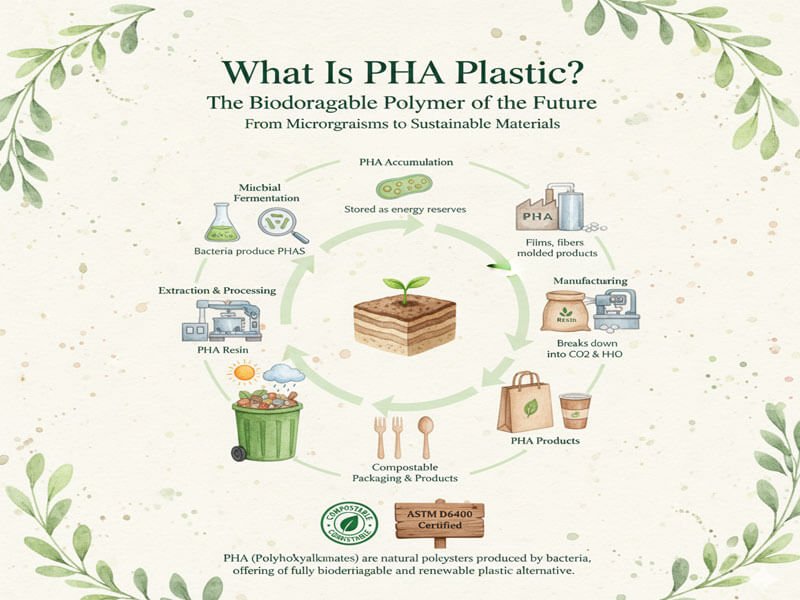
PHA (polyhydroxyalkanoate) is a family of biodegradable polyesters produced by microorganisms.
Certain bacteria naturally produce PHA as an energy storage material when they consume carbon sources such as:
- plant sugars
- vegetable oils
- agricultural waste
During fermentation, these microorganisms accumulate PHA inside their cells. The polymer can then be extracted and processed into plastic materials.
Because PHA originates from biological processes, it is considered a bio-based and biodegradable plastic.
How PHA Bioplastics Are Produced
The production of PHA plastics involves several steps based on microbial fermentation.
Microbial Fermentation
Specific bacteria are cultured in controlled fermentation tanks where they feed on organic carbon sources.
When nutrients become limited, the microorganisms begin storing energy in the form of PHA polymer granules inside their cells.
Polymer Extraction
After fermentation, the microbial cells are harvested and processed to extract the PHA polymer.
The polymer is purified and dried to produce raw bioplastic resin.
Plastic Processing
The resulting PHA resin can be processed using conventional plastic manufacturing methods such as:
- extrusion
- injection molding
- film blowing
This allows PHA to be used in applications similar to traditional plastics.
Properties of PHA Plastic
PHA plastics have several unique characteristics compared with other biodegradable polymers.
Fully biodegradable
PHA can biodegrade in multiple environments, including:
- industrial composting systems
- soil environments
- marine environments
This makes PHA one of the few plastics that can degrade naturally outside controlled composting facilities.
Bio-based origin
PHA is produced from renewable biological resources rather than fossil fuels.
Good barrier properties
PHA materials offer good resistance to moisture and oxygen, which can be beneficial for certain packaging applications.
Thermoplastic behavior
PHA can be processed using standard plastic manufacturing equipment, making it compatible with existing production technologies.
PHA vs PLA vs Starch-Based Plastics
PHA is often compared with other bioplastics such as PLA and starch-based plastics.
| Material | Raw Material Source | Biodegradability | Typical Applications |
|---|---|---|---|
| PHA | Microbial fermentation | Soil, marine, compost | Packaging, medical materials |
| PLA | Plant sugars (corn, sugarcane) | Industrial composting | Packaging, disposable products |
| Starch-based plastics | Corn or cassava starch | Industrial composting | Compostable bags, films |
Compared with PLA and starch plastics, PHA generally has broader biodegradation environments, although production costs are currently higher.
For material comparisons see:
Applications of PHA Bioplastics
PHA is being explored for a wide range of applications where biodegradable materials are required.
Common applications include:
- sustainable packaging films
- disposable food service products
- agricultural films
- medical implants and sutures
- biodegradable consumer products
In packaging industries, PHA can be blended with other biodegradable polymers to improve flexibility and processing performance.
Environmental Advantages of PHA Plastics
PHA plastics offer several environmental benefits compared with conventional plastics.
Reduced plastic pollution
Because PHA can biodegrade in natural environments, it may help reduce long-term plastic accumulation.
Renewable production
PHA is produced from renewable organic materials rather than petroleum.
Compatibility with composting
Certain PHA materials can meet compostability standards such as:
- ASTM D6400
- EN 13432
These certifications ensure the material breaks down safely during composting.
Limitations of PHA Plastic
Despite its advantages, PHA plastic also faces several challenges.
Higher production cost
PHA production through fermentation is currently more expensive than producing conventional plastics.
Limited large-scale supply
Global production capacity for PHA is still relatively small compared with other bioplastics such as PLA.
Processing complexity
Some PHA grades require specialized processing conditions to achieve optimal performance.
However, ongoing research and industrial development are expected to improve production efficiency and expand applications in the coming years.
Conclusion
PHA plastic represents one of the most promising developments in the field of biodegradable materials.
Produced through microbial fermentation and derived from renewable resources, PHA offers unique biodegradability across multiple environments, including soil and marine systems.
Although production costs remain higher than other bioplastics, continued technological progress may enable broader adoption in sustainable packaging and biodegradable product markets.
As global regulations and environmental awareness continue to evolve, PHA is expected to play an increasingly important role in the future of biodegradable plastics.
FAQ
What does PHA stand for?
PHA stands for polyhydroxyalkanoate, a family of biodegradable polyesters produced by microorganisms through fermentation.
Is PHA plastic biodegradable?
Yes. PHA plastics are biodegradable and can break down in soil, marine environments, and composting systems.
Is PHA better than PLA?
PHA generally biodegrades in more environments than PLA, but PLA is currently more widely produced and more cost-effective for large-scale packaging.
Is PHA compostable?
Some PHA plastics can meet compostability standards such as ASTM D6400 or EN 13432 when processed under industrial composting conditions.