As demand for sustainable packaging grows, many products are labeled as “compostable.” However, not all compostable certifications mean the same thing.
Two commonly seen labels in compostable packaging are OK Compost and Home Compost certifications issued by TÜV Austria. These labels indicate how and where a product can break down during composting.
Understanding the difference between these certifications is essential for businesses, waste management systems, and consumers choosing compostable materials.
For a broader overview of global compostable certification systems, see our guide to compostable certifications.
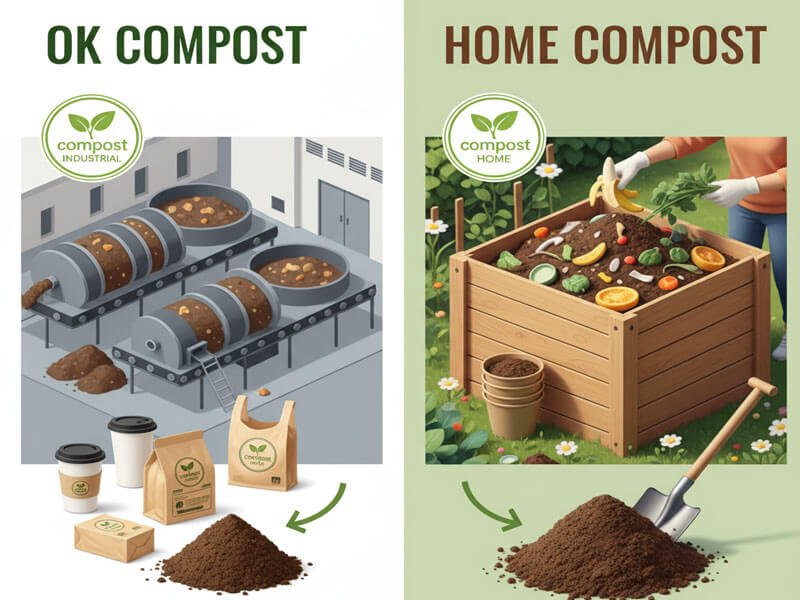
What Is OK Compost Certification?
OK Compost is a certification issued by TÜV Austria that verifies whether a product can break down in industrial composting facilities.
Industrial composting environments are highly controlled systems designed to process organic waste efficiently. These facilities typically maintain:
- temperatures between 55–60°C
- controlled moisture levels
- active microbial activity
Under these conditions, certified materials break down into water, carbon dioxide, and biomass without leaving harmful residues.
Many compostable plastic products that meet OK Compost Industrial requirements also comply with international standards such as ASTM D6400 or EN 13432.
What Is Home Compost Certification?
Home Compost certification indicates that a product can break down in home composting systems, such as backyard compost bins.
Unlike industrial composting facilities, home compost environments are less controlled and typically have:
- lower temperatures
- inconsistent moisture levels
- slower microbial activity
Because of these conditions, materials certified for home composting must degrade effectively at lower temperatures and over longer periods of time.
Home compostable certification is therefore considered more demanding than many industrial compost certifications.
Products certified for home composting often carry labels such as OK Compost HOME.
OK Compost vs Home Compost: Key Differences
Although both certifications indicate compostable materials, they apply to different composting environments.
| Feature | OK Compost | Home Compost |
|---|---|---|
| Composting environment | Industrial composting facilities | Home compost bins |
| Temperature | High (55–60°C) | Lower temperatures |
| Degradation speed | Faster | Slower |
| Composting control | Highly controlled | Less controlled |
| Typical label | OK Compost Industrial | OK Compost HOME |
In general, products that pass Home Compost certification can also break down in industrial composting facilities, but the reverse is not always true.
Why Compostable Certifications Matter
Certification plays an important role in preventing greenwashing and ensuring that compostable products perform properly in real waste systems.
Without recognized certification standards, some products labeled as biodegradable may still leave plastic residues or fail to break down under normal composting conditions.
Certified compostable materials must meet strict requirements for:
- biodegradation performance
- disintegration during composting
- heavy metal limits
- plant toxicity safety
These requirements help ensure that compostable plastics do not contaminate organic waste streams.
To learn more about Australian compostable standards, see AS4736 vs AS5810.
Common Applications of Certified Compostable Materials
Compostable certifications are widely used for products designed to be disposed of with organic waste.
Common examples include:
- compostable garbage bags
- food waste collection liners
- compostable shopping bags
- compostable dog waste bags
- compostable packaging films
For commercial supply options, see our compostable bag manufacturing solutions .
How to Identify Certified Compostable Products
When purchasing compostable packaging, it is important to verify certification labels and documentation.
Key steps include:
Check certification logos
Look for official certification marks such as:
- OK Compost Industrial
- OK Compost HOME
- BPI Certified Compostable
Verify certification documentation
Reliable suppliers should provide:
- certification certificates
- laboratory testing reports
- product specifications
These documents help confirm that the materials meet recognized compostable standards.
Conclusion
OK Compost and Home Compost certifications both indicate that a product can break down through composting, but they apply to different environments.
OK Compost certification focuses on industrial composting systems, where conditions are carefully controlled. Home Compost certification verifies that materials can degrade in backyard compost systems with lower temperatures.
Understanding these differences helps businesses and consumers choose compostable products that are compatible with their local waste management infrastructure.
FAQ
What is the difference between OK Compost and OK Compost HOME?
OK Compost usually refers to industrial composting certification, while OK Compost HOME indicates that a product can break down in home compost systems with lower temperatures.
Can industrial compostable products break down in home compost?
Not always. Materials designed for industrial composting may require higher temperatures to degrade efficiently and may not fully break down in home compost conditions.
Are home compostable materials better for the environment?
Both certifications serve different purposes. Home compostable materials provide flexibility for consumers who compost at home, while industrial compostable products support municipal composting infrastructure.
Who issues OK Compost certification?
OK Compost certification is issued by TÜV Austria, an internationally recognized certification body for compostable materials.